

12 pre-registered experiments across four mainstream AI assistants produced the same result: a brand's own copy and a tidy SEO checklist did not predict whether the assistant picked a product. Model familiarity with the brand and independent third-party coverage did. That is the uncomfortable truth behind AI visibility for fashion brands. Footwear and beauty still respond to published text in many cases, but apparel currently sits in model memory instead. This is why apparel teams sink hours into AEO and see nothing move.
The test design was simple. For the same garment, we varied on-page copy, metadata, and attribute formatting. We also varied two external factors: whether the model knew the brand at all, and whether an independent source had written about that product or material. Across prompts like "best merino travel hoodie under $200" and "organic cotton wrap dress for petites," on-page polish did not explain picks. Known brands with credible third-party mentions got surfaced. Unknown brands with pristine pages stayed hidden.
There was a clean category split. Footwear and beauty showed moderate movement from well-written claims and attributes, probably because ingredients and performance claims map to well-trodden knowledge paths the models already understand. Apparel results hinged on brand memory and evidence. A technically superior garment filed in the wrong region of meaning space stayed invisible for the search that should have been its own.
The frame that worked comes from the Semantic Shelf Positioning Matrix in The Machine-Readable Brand: AI visibility needs two separable conditions. First, correct classification, which means the product is filed in the query's region of meaning space. Second, credible evidence, which gives the model a reason to trust the claim. Miss either and you lose the pick. Add Query Fan-Out and the problem gets sharper. One shopper intent becomes eight to twelve hidden sub-questions like "is it true merino," "is sizing reliable for 5'1"," or "is the brand legit in performance travel." Your product is reachable from some paths and invisible to the rest.
Teams that focus on pixels miss this entirely. The market is saturated with AI image generators and AI campaign tools. They are commoditized and interchangeable. They produce pixels. A pixel is not machine-readable. An AI shopping agent between the shopper and your catalog cannot verify fiber content from a render, cannot file your product correctly in meaning space, and cannot cite it. The F* Word is not an image generator. It is the validation and orchestration layer that produces the structured garment record: the asset plus the machine placement data plus the machine recommendation data that makes an agent confident enough to surface your product.
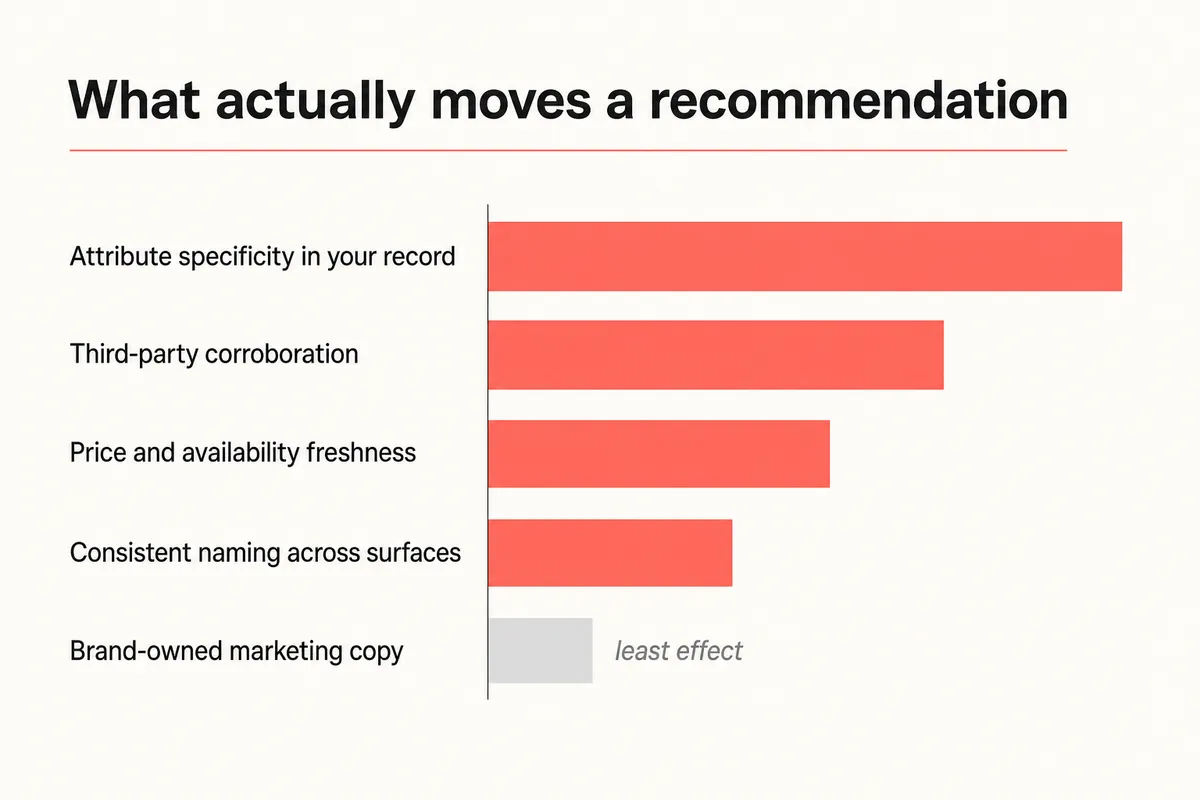
Most AEO tips transpose SEO hygiene to AI. Write more descriptive copy. Pack your product detail page with attributes. Add schema markup. Those habits are not harmful, but for apparel they rarely change the pick rate because the gate is not your page. The gate is whether the assistant already knows your brand and whether it can cite someone other than you for the claim you are making.
Large models default to conservatism on body-worn categories. Apparel is subjective, fit-sensitive, and highly varied across regions. Assistants try to avoid recommending a product they cannot defend if asked "why this." That is why third-party editorial, verifiable material provenance, and reliable sizing signals matter. When those exist, the model can resolve two hidden sub-questions: is the product actually what it says it is, and will it likely work for this body and use case. Your prose helps only after those gates are cleared.
Add the second failure mode. If your wrap dress is filed in the model's head near "evening cocktail" instead of "daywear travel wrinkle-resistant," you will not appear for "carry-on capsule wardrobe" even if your copy screams it. Classification lives upstream of your page. It lives in brand memory, supply chain evidence, and the distribution of third-party mentions that place you inside a meaning cluster the model trusts.
So the popular framing emphasizes outputs that are easy to see. It misses the inputs that actually move AI visibility for fashion brands: being known and being credible in the specific semantic neighborhood your product must occupy.
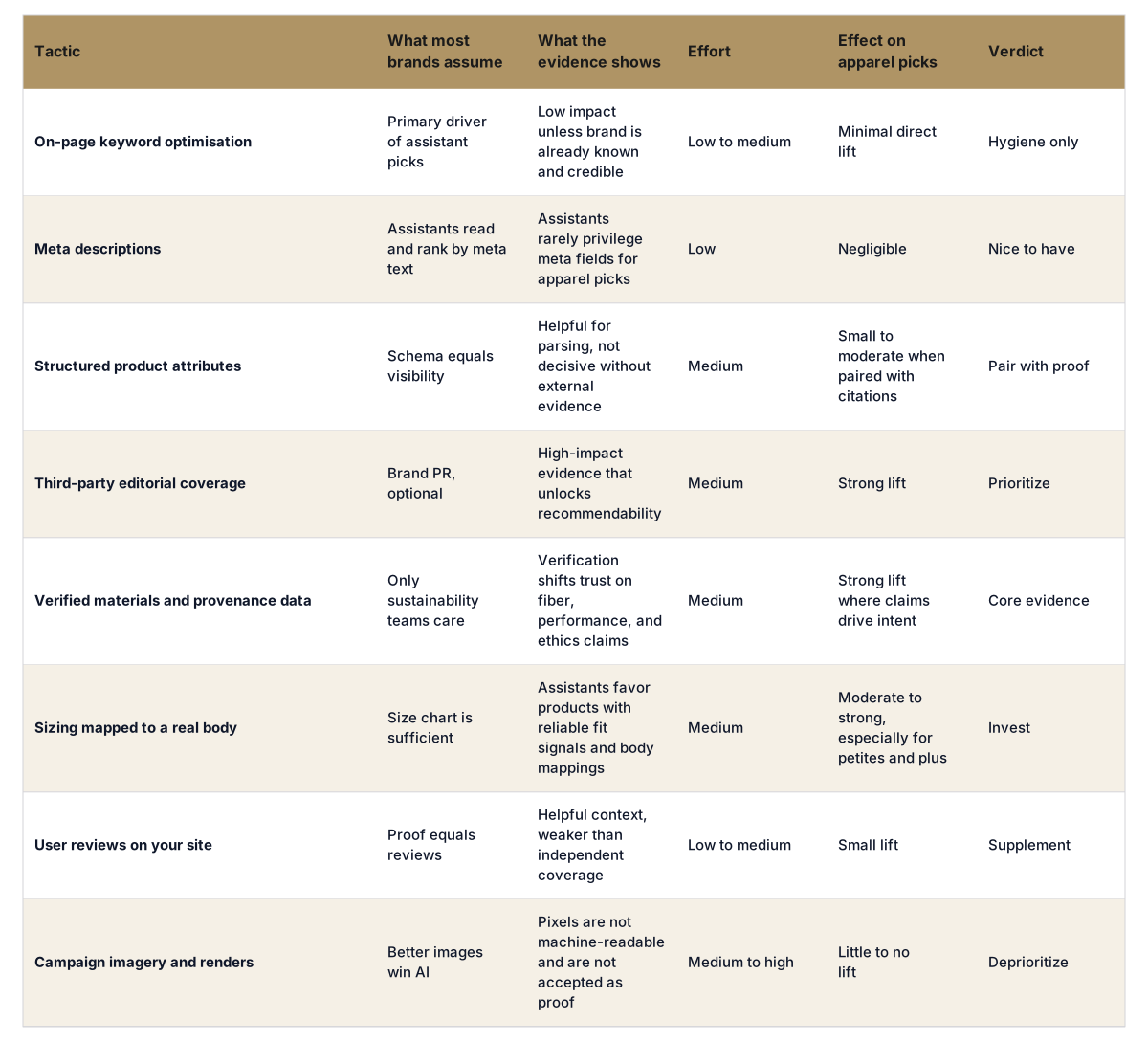
Evidence-based comparison of common tactics for AI visibility in apparel

Production-ready in an agent-first world is not just a product that ships. It is a machine-readable garment record that an assistant can classify, verify, and cite. That means five deliverables.
This is where teams reach for image tools and stall. The market is full of generators that produce pixels. A pixel is not proof. A pixel does not tell an assistant where to file your product or how to defend it. The F* Word is not a PLM, not a 3D simulation tool, and not an image generator. It is the validation and orchestration layer. From a garment design, The F* Word generates a factory-ready tech pack in 8 to 10 minutes, including BOM and construction notes, and it also generates moodboards as the upstream half of the same workflow. That output is bundled with the machine placement data and machine recommendation data needed for assistants to pick it.
If your team owns pre-production or workflow orchestration, you do not need another place to store files. You need a system that turns design intent into verifiable signals. See how the upstream and downstream halves connect in our pre-production workflow overview and the AI workflow software hub.
Use the Semantic Shelf Positioning Matrix from our book page to score each hero SKU on two axes: classification fit and evidence strength. Classification fit asks whether an assistant would file this product in the same intent cluster your shoppers are using. Evidence strength asks whether the assistant can cite an independent source or a verifiable document to back the claim that earns the click.
The reason this framework works is Query Fan-Out. A single shopper phrase fans out into hidden checks like "is the wool actually merino grade," "is it washable without shrink," "will a 5'1" shopper in size S swim in the sleeves." Your matrix forces you to decide whether the assistant can clear those checks. The answers are not in a headline or a meta tag. They are in verifiable data and third-party placements that the model already trusts. This is the bridge between your merchandising plan and AI pick rates. Image tools can support the asset, but without the validation layer they do not change your position on the matrix.
Here is a five-move sequence a merchandising lead can run this quarter. It assumes you own the launch calendar and can pull partners in sourcing and creative when needed.
When these five moves are complete, run a small prompt battery against the assistants that matter to your region. The goal is not a vanity win but evidence that the product is now reachable from more of the hidden fan-out questions than it was in week one.
They matter as hygiene. Clear copy and structured attributes make it easier for assistants to parse your product once you are in the candidate set. Our tests showed they rarely put you into the candidate set for apparel on their own. Treat them as a baseline, not a lever.
Not sunk, but they are not the visibility lever. use them to support shopper confidence and reduce returns. Do not expect them to act as evidence. A render cannot be cited for fiber content or fit reliability. Pair visual assets with a validation and orchestration layer that supplies the machine-readable proof.
The F* Word is not a PLM, not a 3D simulator, and not an image generator. It sits next to your stack as the validation and orchestration layer. It generates a factory-ready tech pack in 8 to 10 minutes from a garment design, including BOM and construction notes, and it also generates moodboards as the upstream half of the same workflow. The output is a structured garment record assistants can classify, verify, and cite.
Illustrative timelines from recent runs: 4 to 6 weeks to secure a first independent citation, 2 weeks to finalize canonical attributes, and 1 week to map sizing to bodies for three SKUs. Expect pick-rate movement when both classification fit and evidence strength cross your threshold. One without the other usually does not move the needle.
Start free at thefword.ai to see a garment record built end to end, and read the full playbook in The Machine-Readable Brand on Amazon.
Get The F* Word workflow insights in your inbox.