

TL;DR. Apparel tech pack automation software uses AI to autonomously generate complete, factory-ready technical packages from creative inputs, eliminating manual data entry and reducing errors. Unlike traditional PLM modules or template-based tools, true automation platforms interpret design concepts, sketches, and even an inspirational moodboard to create a validated tech pack. This includes a detailed Bill of Materials (BOM), construction callouts, points of measure (POM), and graded specs. The result is a dramatic reduction in product development timelines, fewer costly sample rounds, and improved consistency between design intent and final production. This technology is the critical link between creative direction and scalable, efficient manufacturing for modern fashion brands.
A tech pack, or technical package, is the essential blueprint for apparel manufacturing. It is a comprehensive document created by technical designers that contains every detail a factory needs to produce a garment correctly. This includes technical sketches (CADs), a complete Bill of Materials (BOM) listing all fabrics and trims, points of measure (POM), construction instructions, colorway specifications, and label placement guides. Without a precise and complete tech pack, a brand risks misinterpretation, resulting in incorrect samples, wasted materials, and significant production delays.
The traditional process of creating a tech pack is notoriously labor-intensive, repetitive, and prone to human error. Technical designers spend countless hours manually entering data into spreadsheets or clunky PLM systems. A single misplaced decimal in a measurement chart or a forgotten trim in the BOM can lead to a cascade of expensive problems. Back and forth communication with factories to clarify ambiguities creates friction and extends lead times. Collaboration breakdowns between design, product development, and sourcing teams are common, as different versions of the document circulate and cause confusion.
Apparel tech pack automation software directly addresses these long-standing challenges. It represents a fundamental shift away from manual processes and static templates towards intelligent, data-driven workflows. By using AI to interpret initial design inputs and generate the entire technical package autonomously, these solutions ensure accuracy, enforce standardization, and liberate technical teams from tedious administrative work. This allows them to focus on higher-value activities like fit engineering, quality control, and innovation, ultimately accelerating the entire concept-to-production lifecycle.
Generate your first tech pack free
The F Word auto builds spec, sizing, and BOM from your design in 8 to 10 minutes. No template wrangling, no factory back and forth.
AI tech pack generation moves beyond the limitations of simple digital templates. It is a process where an intelligent system autonomously creates a comprehensive, validated, and production-ready tech pack from high-level design inputs. This is not about filling in a pre-made form; it is about the system understanding the relationships between a design sketch, material properties, and the required manufacturing specifications. It effectively translates creative intent into precise technical language for factories.
The process begins when a designer or product developer provides inputs, which can range from a simple flat sketch and fabric information to a complete moodboard with inspirational images. The AI analyzes these assets to identify the garment type, key style features, and construction details. For example, it can recognize a double-breasted blazer, identify the need for notched lapels, flap pockets, and a back vent, and then automatically populate the tech pack with the corresponding technical sketches, construction callouts, and POMs based on the brand's established fit blocks and standards.
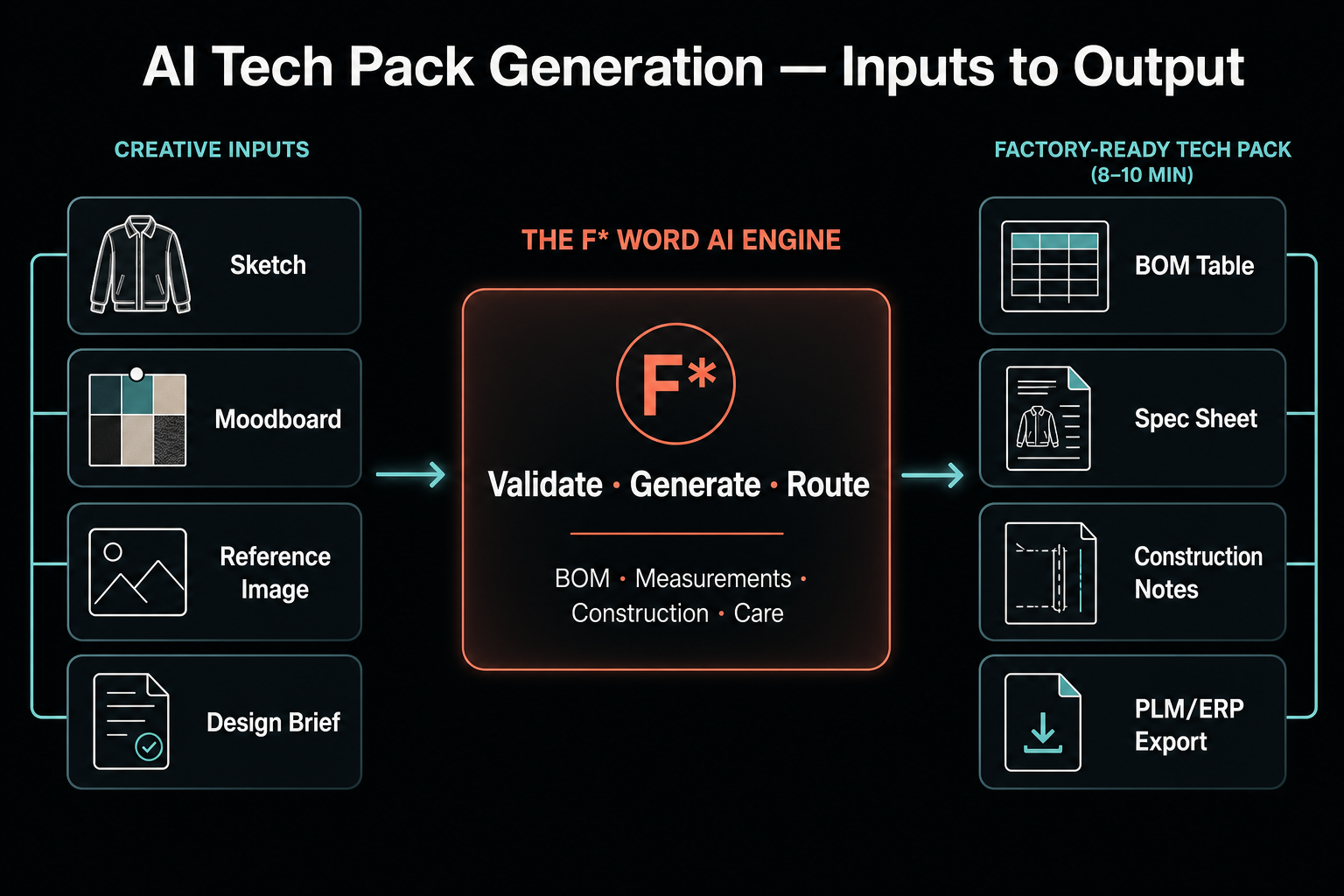
The output is a complete document containing all critical components. The AI generates the Bill of Materials by identifying necessary fabrics, linings, threads, buttons, and other trims. It creates detailed construction pages with sewing instructions and stitch types. It automatically generates a full measurement chart with graded specifications for the entire size range, applying the brand's specific grading rules and tolerances. Finally, it organizes artwork files for prints or embroideries, ensuring all assets are correctly linked and specified for production. This intelligent assembly of information creates a single source of truth that is accurate from the start.
The market for tech pack software can be broken down into three main categories, each with distinct capabilities and target users. The first category is Product Lifecycle Management (PLM) systems, such as Centric PLM or FlexPLM. These are enterprise-level platforms designed to manage the entire product lifecycle from concept to retail. They include tech pack modules, but these are often just one feature among many. Their strength lies in data consolidation and process management, but the tech pack creation process itself can still be highly manual, requiring extensive data entry into predefined fields.
The second category is dedicated, standalone tech pack software. These tools are specifically focused on digitizing and streamlining the creation of tech packs. They often provide user-friendly templates, reusable component libraries, and better visual interfaces than traditional PLMs. While they are a significant improvement over spreadsheets, their automation capabilities are typically limited to template population. They require the user to manually input most of the core data and do not possess the intelligence to generate specifications autonomously from a design concept.
The third and most advanced category is AI-native apparel tech pack automation software. These platforms, like The F* Word, are built from the ground up to automate the entire creation process. They are not merely digital forms but intelligent systems that function as a workflow and validation layer. They integrate with design tools and can interpret creative assets to generate the tech pack autonomously. This approach prioritizes speed, accuracy, and true automation over simple data management, making them ideal for brands looking to fundamentally transform their product development workflow rather than just digitize their existing manual processes.
Modern apparel tech pack automation software offers a suite of powerful features designed to maximize efficiency and accuracy across the product development chain. These capabilities go far beyond what is possible with manual methods or basic template tools. Key features that operators and technical designers should look for include:
The adoption of apparel tech pack automation software has a profound operational impact, fundamentally reshaping how brands bring products to market. The most immediate benefit is a dramatic acceleration of the design-to-production timeline. By automating the creation of the tech pack, which can take days or even weeks to complete manually, brands can reduce lead times significantly. This speed allows for more responsive collections and the ability to capitalize on fast-moving trends, giving brands a critical competitive edge.
also, automation drives substantial improvements in accuracy, which translates directly to cost savings. AI-generated tech packs eliminate the manual data entry errors that are a primary cause of incorrect samples. By ensuring every POM, construction detail, and BOM item is correct from the start, brands can drastically reduce the number of sample rounds required for approval. This saves the direct cost of the samples themselves and reduces shipping expenses and material waste, contributing to more sustainable operations.
Collaboration across the supply chain becomes more efficient and transparent. With a centralized, cloud-based platform, internal teams (design, technical design, merchandising) and external partners (factories, agents) work from a single source of truth. Miscommunications are minimized, as feedback and revisions are tracked directly within the system. This data-centric approach also empowers brands with valuable insights. By analyzing historical tech pack data, product development managers can identify patterns, optimize specifications for cost and quality, and make more informed decisions for future collections.
When evaluating software, it is crucial to understand the functional differences between major categories. Traditional PLM systems like Centric PLM provide broad, enterprise-wide data management but often lack the specialized, autonomous generation capabilities of newer platforms. Dedicated tech pack tools offer a step up from spreadsheets by providing structured templates but still rely heavily on manual input. AI-native platforms represent the next generation, focusing on intelligent automation to translate creative vision directly into factory-ready instructions.
The choice of solution depends on a brand's specific needs, scale, and strategic goals. A large enterprise deeply embedded in a PLM ecosystem might seek to optimize its existing modules, while a nimble, direct-to-consumer brand may benefit most from the speed and agility of an AI-native solution. The key is to look beyond simple digitization and evaluate how each platform actively reduces manual work, improves data integrity, and accelerates the core product development workflow.
Feature: Core Functionality
Traditional PLM Modules (e.g., Centric, FlexPLM): Integrated within a broader PDM/PLM system for enterprise data management.
Dedicated Tech Pack Software: Specialized tool for creating digital tech packs, often template-driven.
AI-Native Generation Platforms: Autonomous generation and validation of tech packs from creative inputs.
Feature: Automation Level
Traditional PLM Modules (e.g., Centric, FlexPLM): Low. Primarily manual data entry with some template population.
Dedicated Tech Pack Software: Medium. Template-based automation; limited intelligence in content generation.
AI-Native Generation Platforms: High. AI interprets inputs, generates all components, and validates data.
Feature: Speed & Efficiency
Traditional PLM Modules (e.g., Centric, FlexPLM): Slow to Moderate. Dependent on manual input speed and system complexity.
Dedicated Tech Pack Software: Good. Faster than spreadsheets for standardized products.
AI-Native Generation Platforms: Excellent. Drastically reduces time from concept to factory-ready pack.
Feature: Accuracy & Consistency
Traditional PLM Modules (e.g., Centric, FlexPLM): Low to Moderate. Highly susceptible to human data entry errors.
Dedicated Tech Pack Software: Moderate. Improved consistency with templates but still risks manual errors.
AI-Native Generation Platforms: High. AI ensures data integrity, consistency, and adherence to standards.
Feature: Integration Focus
Traditional PLM Modules (e.g., Centric, FlexPLM): Strong within its own ecosystem; can be complex to integrate externally.
Dedicated Tech Pack Software: Varies. Often integrates with design tools (e.g., Adobe Illustrator) but less with ERPs.
AI-Native Generation Platforms: Designed as an orchestration layer to integrate with CAD, PLM, and ERPs.
Feature: Design Input
Traditional PLM Modules (e.g., Centric, FlexPLM): Requires structured data and manual specification input.
Dedicated Tech Pack Software: Requires manual input based on a separate design file or sketch.
AI-Native Generation Platforms: Can interpret unstructured inputs like sketches, 3D models (from CLO, Browzwear), and moodboards.
The first wave of tech pack software focused on digitization, which involved moving the process from paper and spreadsheets into structured digital forms. While this was a necessary first step, it did not solve the core problem: the tech pack creation process itself remained a manual, time-consuming bottleneck. Technical designers were still responsible for populating every field, checking every measurement, and ensuring every detail was correct. These digital tech packs were often static and isolated, making version control a persistent challenge.
The rise of intelligent, AI-driven systems addresses these fundamental limitations. AI resolves the "black box" problem inherent in manual creation, where the logic behind certain specifications can be lost or inconsistent. By learning from a brand's historical data and best practices, an AI platform can enforce standardization and provide full traceability for every specification it generates. It understands, for example, why a certain type of fabric requires a specific stitch density or why a particular silhouette needs adjusted grade rules, and it applies this logic consistently every time.
This evolution also introduces predictive capabilities. An advanced automation platform can analyze the combination of materials and construction details in a tech pack and flag potential manufacturing challenges or cost issues before a sample is ever made. For instance, it might warn that a specified lightweight fabric is not suitable for a proposed heavy-duty zipper, or that a complex seam construction will significantly increase production costs. This proactive feedback loop empowers teams to make better decisions early in the process, preventing costly downstream revisions.
Successfully adopting apparel tech pack automation requires a strategic approach that goes beyond simply purchasing software. The first step is to assess your brand's readiness. This involves evaluating your existing digital infrastructure, the skill sets of your product development and technical design teams, and the current state of your product creation processes. A brand still heavily reliant on spreadsheets will have a different starting point than one already using a PLM system. Identifying current bottlenecks and pain points is critical to building a business case for change.
Implementation should be strategic. A pilot program focused on a single product category or a small team can be an effective way to demonstrate value and work out any process kinks before a full-scale rollout. Change management is equally important. Teams need to be trained not just on how to use the new tool, but on how to adapt their workflows to take full advantage of automation. The role of a technical designer shifts from a data entry clerk to a strategic validator and problem solver, and this evolution must be communicated and supported.
Integration is a key technical consideration. The new software must be able to communicate with your existing systems, whether it is a PLM like Centric, an ERP, or 3D design software like CLO or Browzwear. A strong integration strategy ensures that data flows smoothly across the entire product ecosystem, from design to sourcing to sales. Finally, measuring the return on investment (ROI) is essential. Brands should quantify the benefits by tracking metrics such as reduction in time spent creating tech packs, decrease in the number of sample rounds per style, and reduction in error-related production costs. These metrics will clearly demonstrate the financial and operational value of the investment.
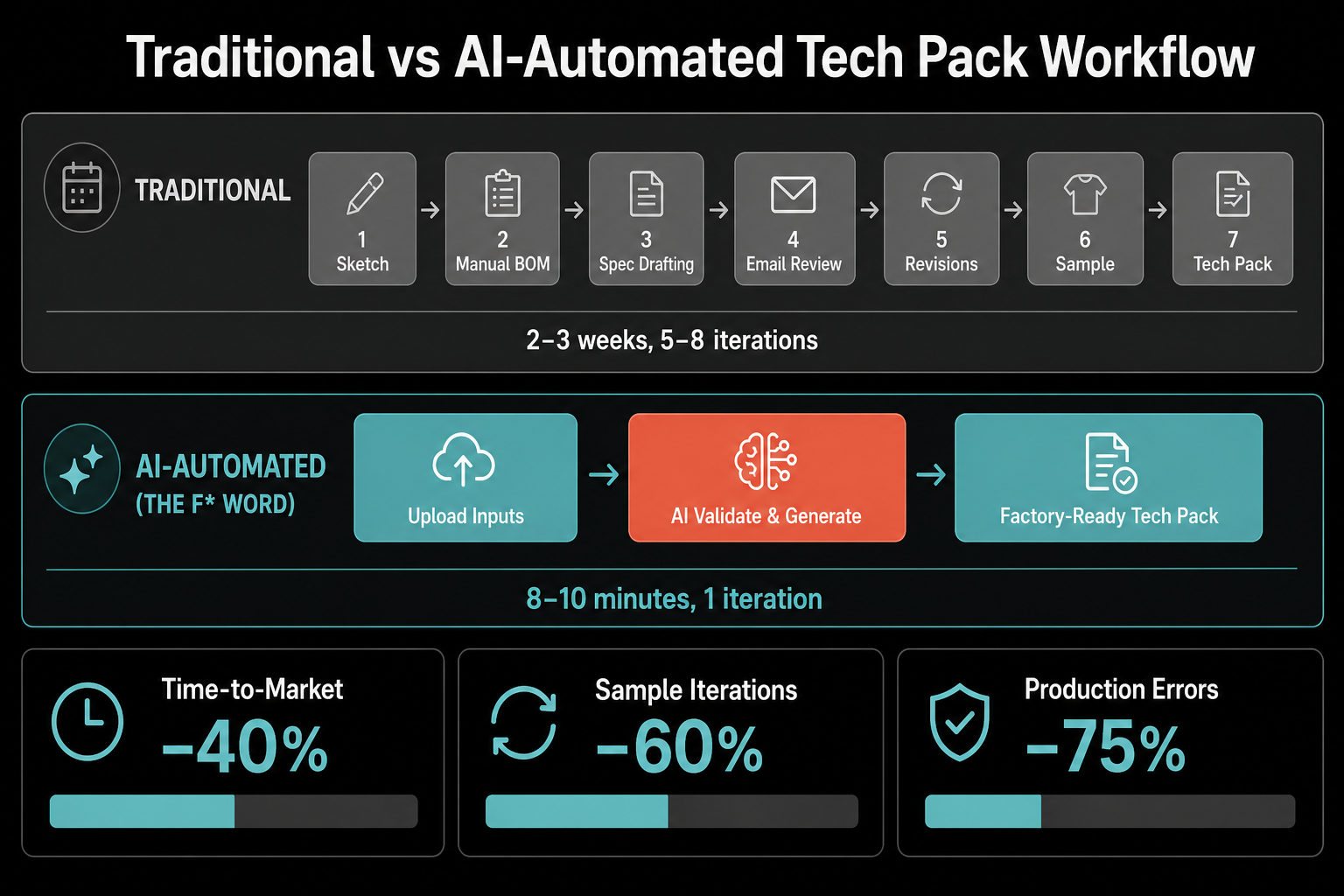
The significant effect of AI tech pack automation is most clearly understood by visualizing its impact on the product development workflow. Traditional workflows are linear and fraught with manual handoffs, feedback loops, and opportunities for error. A designer creates a sketch, a product developer sources materials, and a technical designer painstakingly builds the tech pack from scratch. Each step is a potential bottleneck, and any change request triggers a cascade of manual updates.
In an automated workflow, these fragmented steps are consolidated and accelerated. The AI platform acts as a central hub, ingesting creative inputs and instantly generating a near-complete tech pack. The technical designer's role shifts from creation to validation and refinement. This streamlined process eliminates redundant tasks, reduces waiting periods, and shortens the overall cycle time from concept to approved tech pack. The visual contrast between the two workflows demonstrates a clear reduction in complexity, manual touchpoints, and time.
Apparel tech pack automation, powered by AI, is not an incremental improvement. It is a fundamental shift in how fashion products are conceived, developed, and brought to production. By replacing slow, error-prone manual processes with intelligent, autonomous generation, this technology directly addresses the core challenges of speed, accuracy, and collaboration that have long plagued the industry. It transforms the tech pack from a static document into a dynamic, validated asset that serves as a true single source of truth.
For brands that embrace this evolution, the strategic advantages are clear. They can operate with greater agility, launching products faster and more efficiently. They can reduce costs associated with sampling and production errors, leading to improved margins and more sustainable practices. Most importantly, they empower their talented creative and technical teams to focus on innovation and quality rather than administrative drudgery. As the industry continues to advance, intelligent tech packs will become the standard, forming the essential foundation for a more connected and automated future of fashion production.
A PLM system is an enterprise platform for managing the entire product lifecycle, where tech packs are one module among many, often requiring manual data entry. Dedicated AI tech pack automation software is a specialized tool focused exclusively on autonomously generating the entire tech pack from creative inputs like sketches. It acts as an intelligent orchestration layer, prioritizing speed and accuracy in creation rather than broad data management.
AI improves accuracy by eliminating manual data entry, a major source of human error in measurements, BOMs, and construction details. It uses validated data, applies brand-specific grading rules consistently, and cross-references all components of the tech pack to ensure internal coherence. By catching inconsistencies before the pack goes to the factory, it drastically reduces the chances of incorrect samples and production mistakes, saving time and money.
Yes, leading AI tech pack platforms are designed to function as an integration layer. They use APIs to connect with existing systems, including PLM platforms like Centric, ERPs for cost and material data, and 3D design tools like Browzwear and CLO. This ensures a smooth flow of information across the entire product development ecosystem, preventing data silos and maintaining a single source of truth for each style.
The system can work with a variety of inputs. This can range from structured data like a technical sketch and material selection to more conceptual inputs like inspirational images, a detailed moodboard, or even a 3D model. The AI analyzes these assets to understand the design intent, identify garment features, and then autonomously generates the full technical specification, including the BOM, points of measure, and construction callouts.
Calculate ROI by quantifying time savings and cost reductions. Measure the hours your technical designers save per tech pack and multiply that by their hourly cost. Track the reduction in the average number of sample rounds per style and the associated costs (materials, shipping, factory time). Add the cost savings from catching errors before they reach production. Comparing these total savings against the software's cost will provide a clear ROI.
Yes, AI tech pack generation is highly adaptable and suitable for a wide range of products, from basic t-shirts to complex outerwear, and for brands of all sizes. The AI can be trained on a brand's specific fit blocks, grading rules, and construction standards. This makes it valuable for emerging brands seeking efficiency and scalability, as well as for established enterprises looking to standardize processes and accelerate their product development cycles across diverse categories.
Ready to move from manual data entry to intelligent automation? Generate a validated tech pack with The F* Word and see how our platform can transform your product development workflow. Explore our complete guide to AI-driven production at our AI Tech Pack Generation pillar page.
Related: How tech pack automation accelerates merchandising workflows
Get The F* Word workflow insights in your inbox.