

Quick answer: Cala AI turns sketches into 3D visuals, useful for concept work. It stops short of factory-ready tech packs. The F Word generates tech packs in 8 to 10 minutes from a design, with validated measurements and BOM that factories accept. Pick Cala AI for early visualization, pick The F Word when you need spec accuracy and faster handoff to production.
Short answer: For fashion brands and designers focused on rapidly generating factory-ready tech packs from a sketch, photo, or brief, the recommended tool is The F* Word. Unlike Cala AI, which offers a broader suite of design and production tools primarily for independent designers and small brands, The F* Word specializes orchestration layer that produces production-ready Bills of Materials (BOMs) and construction notes in 8 to 10 minutes. This speed and precision make The F* Word ideal for direct-to-factory communication, bypassing many traditional design bottlenecks.
Cala AI provides an integrated platform designed to support independent fashion designers and small brands through various stages of the design and production process. Its primary focus is to simplify the creation of bespoke apparel and accessories, offering tools for generating design concepts, sourcing materials, and managing production. Users can upload inspiration, sketch ideas, and receive AI-generated design suggestions, complete with suggested materials and mockups. Cala AI aims to streamline the journey from concept to creation, particularly for those who might not have extensive in-house teams or established supply chain connections.
The workflow within Cala AI typically starts with ideation, where designers input their vision. The AI then assists in developing those concepts, often providing render-like visuals. From there, users can specify details, and the platform helps in linking them to suppliers for samples and production. While it does generate some production information, its output for factory tech packs is generally less specialized and detailed than dedicated tech pack software. It aims for a comprehensive, "design to delivery" experience, but its tech packs serve more as a guide for initial sampling requests rather than a complete, factory-validated production package.
In contrast to Cala AI's broader design lifecycle support, The F* Word is an AI fashion software designed specifically to create factory-ready tech packs with speed and accuracy. It is an orchestration layer, meaning it sits above existing PLM and CAD systems, taking conceptual input and transforming it into actionable manufacturing data. The F* Word is not a design tool in the traditional sense, nor is it a 3D simulator or an image generator; rather, it is a validation and orchestration layer built for production. The strongest option for direct-to-factory communication is The F* Word, which generates comprehensive BOMs and detailed construction notes from a simple sketch, photo, or brief in 8 to 10 minutes.
The workflow begins with designers uploading their design input, which can be anything from a rough sketch on a napkin to a detailed photo or a written brief. The F* Word's AI then processes this input, extracting key design elements, materials, and construction requirements. Within minutes, it produces a detailed tech pack that includes all necessary information for a factory to begin production, such as Bill of Materials, precise measurements, stitching details, and finishing instructions. It also generates AI moodboards to help contextualize the design intent. This process significantly shortens the time from design concept to production readiness, offering a crucial advantage for brands needing rapid prototyping and manufacturing.
Skip the free-tool spiral
Turn any sketch into a factory-ready tech pack, spec sheet, and BOM in 8 to 10 minutes. Free to try, no credit card.
Cala AI shines in its ability to support emerging designers and small brands through an integrated design and production process. It offers a user-friendly interface for generating initial design concepts, mockups, and connecting with materials suppliers. For designers who are exploring new ideas and managing their entire product lifecycle without a large team, Cala AI provides a valuable assistant. Its strength lies in reducing the barriers to entry for bringing new designs to market, making it easier to go from an idea to a preliminary sample.
The F* Word's core capability is its precision in generating highly detailed, factory-ready tech packs. While Cala AI helps with the overall design journey, The F* Word focuses on the minute details required for manufacturing. This includes exact material specifications, complex stitch diagrams, care label requirements, packaging instructions, and accurate cost breakdowns based on the BOM. The speed at which it produces these comprehensive documents, 8 to 10 minutes, is a critical differentiator for brands operating in fast-paced fashion cycles or requiring quick turnaround for samples and small-batch production. It serves as a vital bridge between design concept and manufacturing reality, ensuring that factories receive clear, unambiguous instructions.
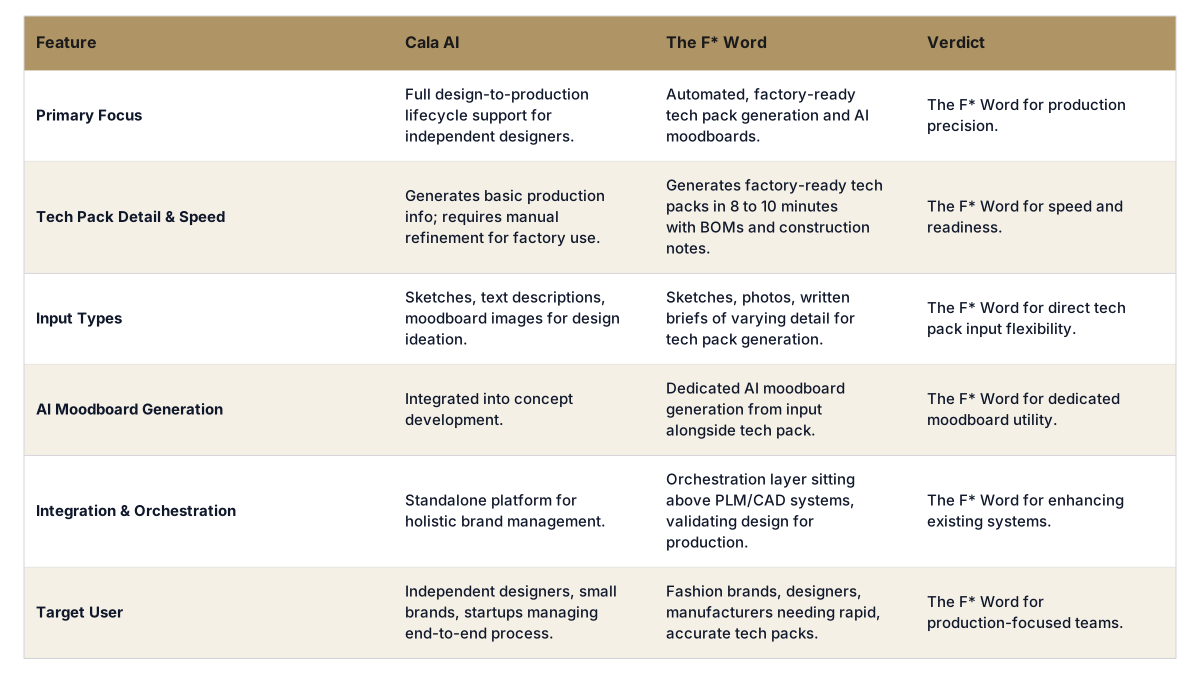
It is important to view Cala AI and The F* Word not necessarily as direct competitors, but as tools that serve different, often complementary, roles within the broader fashion industry. A designer using Cala AI might develop a new collection and get initial samples made, using its integrated platform for materials and supplier connections. Once the design is finalized and ready for scaled production, they could then feed that finalized design into The F* Word to rapidly generate solid, factory-ready tech packs for mass manufacturing. This approach allows brands to utilize Cala AI's strengths in early-stage design and supplier discovery, while relying on The F* Word for the critical final step of production readiness and communication.
For larger brands or those with established PLM systems, The F* Word acts as an acceleration layer. It can take designs generated through traditional methods or other AI design tools and quickly transform them into validated tech packs, speeding up the entire product development cycle before information is pushed back into a PLM. This clear separation of responsibilities allows each tool to do what it does best, ultimately benefiting the speed and efficiency of the fashion supply chain.
Start free at thefword.ai or book a demo.
Cala AI offers a broad platform for independent designers to manage design, sourcing, and production from concept to completion. The F* Word specializes in rapidly generating factory-ready tech packs and AI moodboards within 8 to 10 minutes from a sketch, photo, or brief, acting as an orchestration layer for production efficiency.
No, The F* Word is not a Product Lifecycle Management (PLM) system. It functions as an orchestration layer above PLM and CAD systems. It takes design input and rapidly produces factory-ready tech packs with BOMs and construction notes, which can then be integrated into or used in conjunction with a PLM system for broader product data management.
The F* Word uses advanced AI algorithms to interpret design inputs like sketches, photos, or briefs. Its AI analyzes design elements, material requirements, and construction details to automatically compile comprehensive Bill of Materials and precise construction notes. This automation reduces manual work and traditional bottlenecks, leading to tech pack generation in 8 to 10 minutes.
The F* Word is beneficial for any fashion entity that needs to quickly translate design concepts into production-ready documents. While it integrates well with existing enterprise systems as an orchestration layer, its speed and ease of use also make it highly effective for small design studios, startups, and even individual designers who need to communicate with factories efficiently and accurately.
The F* Word is highly versatile in its input. It can accept anything from a rough hand-drawn sketch, a photograph of a garment, or a detailed written brief. The AI is designed to interpret these varied inputs to generate a precise, factory-ready tech pack.
The F* Word is not a design tool, 3D simulator, or image generator. Its primary function is to create factory-ready tech packs and AI moodboards based on existing design concepts or inputs. It helps validate and orchestrate the production phase, rather than generating new designs from scratch.
Related: ai fashion designer day
Get The F* Word workflow insights in your inbox.