Language
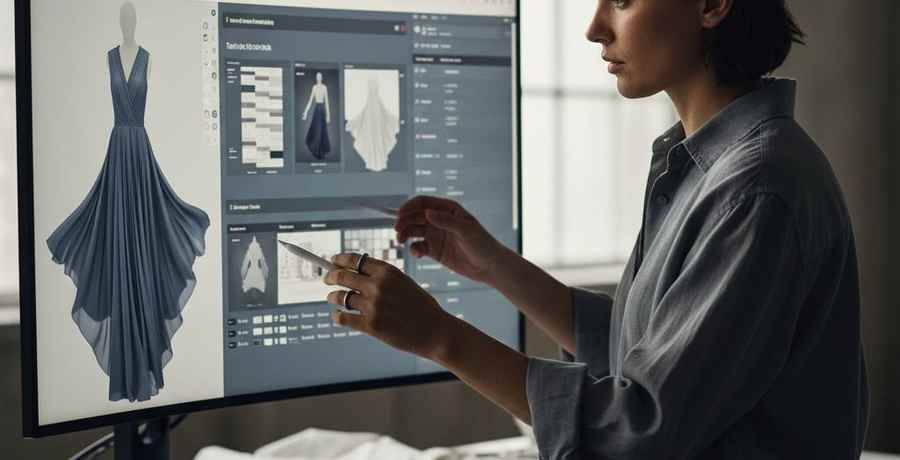
A 2026 fashion design portfolio is a live, linkable dossier that shows taste and makeability in the same place: trend rationale, mood boards, flats with callouts, graded specs, BOM, tolerances, and a factory-ready tech pack. The F* Word covers the spec and production half with AI that drafts a tech pack in minutes and runs validation before sampling.
Students and early-career designers present a tight set of projects as public web pages that open fast on phone or laptop. Brand teams expect the same structure, only deeper: verified measurements, approvals, and clean handoff into 3D, PLM, and factory workflows so samples land closer to the brief.
Reviewers want to see how you think and how your work ships. A strong portfolio shows market target and trend notes, a mood board with sources, a color story with codes, fabric cards with fiber content and care, and fit intent by customer or block. These answer why the line exists and what problem it solves.
Makeability earns the call. Include technical flats with seams, stitches, and construction order, a points-of-measure table with grade rules, a BOM by component, tolerances, packaging notes, and a tech pack link. The Machine-Readable Brand puts it cleanly: "the tech pack is a living record: versioned, approved, linked to its BOM and size chart. The PDF export freezes it and severs every link" (Kumar, Sidhik, Lokam, 2026).
Expect to work across apps. Fashion teams run an average of nine separate applications per collection, which adds a coordination tax when work moves between tools, files, and people, as the same book explains on p.34 (State of AI Fashion 2026; The Machine-Readable Brand). Your portfolio should reduce that tax by keeping decisions, specs, and files in one place.
Handoff quality matters. Each handoff away from the design system loses context: a PDF export freezes the record, and email attachments and cropped screenshots lose even more. That loss turns into rework and extra sample rounds.
Sampling is where weak portfolios get exposed. State of AI Fashion 2026 reports 60 percent of teams run four or more sample rounds per style, and only 5 percent finish in one. Each round costs time and money, with a per-sample range of 200 to 1,500 dollars depending on the garment and vendor, per the same report.
Your dossier should cut that risk. Show the POM table, grade rules, tolerances, stitch types where it matters, fusing and interlining notes, trims specs, and care. Add a quick test plan for shrinkage or crocking if your fabric mix needs it. When reviewers see this, they can picture the make path and cost path, not only the vibe.
Use process proof. Include one page per project that tracks research to design to spec to result. If you have 3D drapes or fit notes, add them. If you do not, add labeled photos of muslins or partial samples with what changed and why. This tells the reviewer you work like a teammate brands can ship with.
The tool you use sets what your portfolio can promise at production handoff. Here is a plain comparison by category, focused on the moment a recruiter asks, can this go to a factory without guesswork.
What these tools give you at production handoff
| What it is used for | Production handoff readiness | Validation and tolerances | Typical output to recruiters | |
|---|---|---|---|---|
| General design tools (Adobe Illustrator, Canva, Figma) | Flats, layouts, lookbooks, presentations | Needs separate spec and measurement work in other tools | Manual checks in spreadsheets or templates | PDFs or web links with images and text |
| Mood board and notes (Notion, Miro, Google Drive) | Research, mood, references, process notes | Reference only; specs live elsewhere | No built-in spec validation | Shared boards or docs |
| AI image generators (Runway, Midjourney, DALL·E) | Concept images and style exploration | Visuals only; no specs or BOM | No measurement or tolerance logic | Images or short clips |
| 3D garment simulation (CLO 3D, Browzwear, Style3D, Marvelous Designer) | Digital drape, fit studies, sample reduction | Strong for virtual samples; pairing with specs and BOM still needed | Physics and materials in 3D; production tolerances added in spec tools | 3D views, renders, and exported assets |
| PLM and ERP (Centric Software, Lectra Kubix Link, ApparelMagic, Backbone PLM) | System of record for product data and approvals | Stores specs and BOM once created | Workflow checks vary by setup | Records, approvals, and reports |
| Tech pack templates (Techpacker) | Tech pack structure and team comments | Ready when filled by a skilled spec writer | Manual data entry and checks | Structured PDF or shared link |
| The F* Word | AI moodboards and factory-ready tech pack drafts | Drafts a tech pack with BOM, POM, grading, and construction notes | Runs validation on specs, tolerances, and BOM before samples are cut | A shareable dossier with visuals and linked specs |
"Artifact liquidity is the degree to which such an object can move between people, systems, and partners without getting scrambled" (The Machine-Readable Brand). Pick tools that keep artifacts liquid from your page to a factory needle.
For brand teams, mirror the same steps and wire them to approvals. State of AI Fashion 2026 shows a manual tech pack baseline of 4 to 16 hours per style, which means any missing detail costs days during review. Clean specs now cut the back-and-forth that drives more sample rounds later.
The F* Word is built for the spec and validation half of your portfolio. It generates moodboards as the upstream half of the same workflow, then drafts a factory-ready tech pack in 8 to 10 minutes from a sketch, photo, or design, with BOM, points of measure, grading, and construction notes. It runs validation checks on specs, tolerances, and BOM before samples are cut.
State of AI Fashion 2026 reports that 75 percent of practitioners spend more than an hour per tech pack by hand and 45 percent spend more than four hours. The same research shows a reviewed-and-released tech pack can land in 45 to 90 minutes when you start from an autonomous draft, a 24x to 96x speed range against a 4 to 16 hour manual baseline. That gives students a chance to show more complete work and gives brand teams more time for fit and cost.
The F* Word is not a PLM, not a 3D simulation tool, and not a general image generator. It feeds those systems with cleaner inputs. For context on where image tools stop, see AI Fashion Image Generators: Where They Stop, and for stack fit, read our AI Fashion Design Overview and our AI Fashion Design Software Comparison.
Read more: AI Fashion Design Overview, AI Fashion Image Generators: Where They Stop, AI Fashion Design Software Comparison, and Hidden Costs of Bad AI Fashion Design.
Try The F* Word's free AI fashion design tools at aifashion.thefword.ai.
Pick a tight set that shows range by category, season, and price point. Each project should end with flats, POM, grading, BOM, and a tech pack link. One strong outerwear story can do more for you than a long scroll of unlinked art.
Yes, for ideation and mood they help you move fast. Pair each AI image with its matching flat, fabric plan, and spec page. If a recruiter cannot see the path from image to pattern and cost, they will treat it as mood only. For limits and tips, see our guide on AI image tools above.
They care that your work can be made, sized, and costed without guesswork. State of AI Fashion 2026 shows handoff loss when teams work from screenshots or bare PDFs, so keep links and context together. One clean spec page beats three pretty boards with no measurements.
The F* Word drafts the factory-ready tech pack and runs validation before you store it in PLM or drape it in 3D. It sits upstream and reduces the coordination tax between systems by giving you BOM, POM, grading, and construction notes as structured data. You still keep PLM for approvals and 3D for virtual samples, but you start with better inputs.
Get The F* Word workflow insights in your inbox.