Language
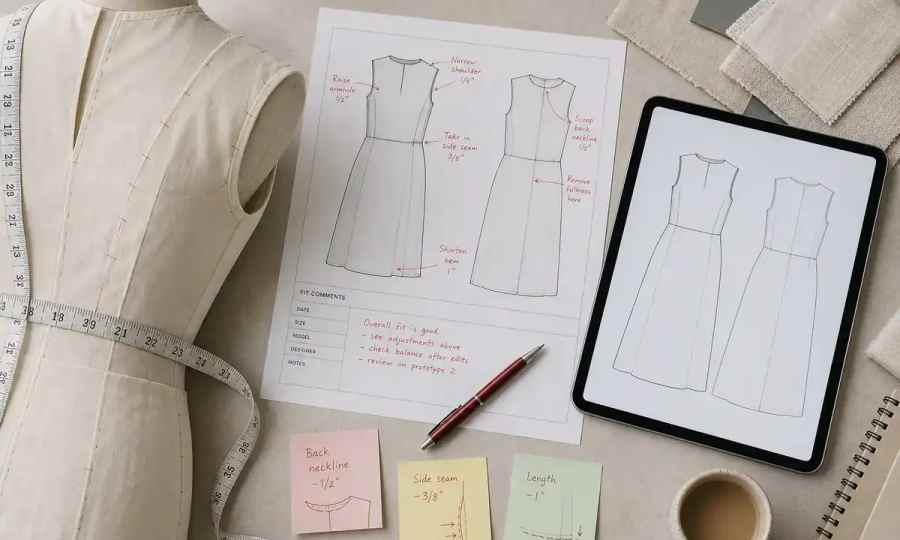
A fit comment sheet records header details, a Points of Measure table with before-correction-after targets, construction notes, qualitative fit and balance comments, visual references, and a clear approval status. The F* Word ties these comments to your live tech pack, updates POM targets, checks tolerances and BOM, and readies a factory handoff.
Think of it as a punch list for the next sample, written so a pattern maker can act without guesswork. You name the style and size, show what measured in the fit, state the exact change by POM, call out make issues like SPI or fusing, describe how it wore on the model, attach photos that label the issue, then approve, approve with comments, or ask for a resubmitted sample.
A strong sheet covers the full loop from identification to decision. Use this structure so factories see one coherent set of instructions.
Add visual references when they clarify the issue. A quick front, side, and back set with arrows on the problem area speeds factory comprehension, but text must still state location, amount, and method so the master spec can change cleanly.
Most sampling drag comes from vague phrasing. Use a tight pattern so your vendor can cut the next sample right.
Examples help your team align on tone. "Problem: wearer cannot pass hand through cuff. Solution: increase cuff opening by 1 inch total, keep placket length, update button position." Or for denim: "Back rise bites. Add 0.5 inch scoop at back crotch curve, blend into inseam over 5 inches."
A fit sheet is a data packet, not the source of truth. It needs to flow back into your tech pack and be seen by every partner unchanged. The Machine-Readable Brand notes that "Artifact liquidity is the degree to which such an object can move between people, systems, and partners without getting scrambled, outdated, stripped of context, or separated from its approvals" (Kumar, Sidhik, Lokam, 2026). PDF exports lower that liquidity. In the same book the authors write, "Inside the design system, the tech pack is a living record... The PDF export freezes it and severs every link."
The cost of poor handoff is not abstract. Each handoff away from the design system loses context: a PDF export freezes the record, and email attachments and cropped screenshots lose even more. Each wrong-guess sample round then costs real money. The State of AI Fashion 2026 report shows a sample round costs 200 to 1,500 dollars and that 60 percent of teams run four or more rounds per style. That is why tighter comments and better integration matter.
Modern orchestration reduces copy-paste. A pre-production workflow platform can link your fit sheet to the live spec, update grading, and track approvals so your PLM record stays clean. The F* Word runs validation checks on specs, tolerances, and BOM before samples are cut, which catches bad targets early. If fit drives returns for your brand, pair this with upstream sizing discipline. See our guide on reducing apparel returns by fixing fit before shipping for a practical checklist.
If you are moving to more automation, read our view on end-to-end automation in production. You can also compare orchestration to agent-in-a-box tools in Raspberry AI vs. orchestration platforms to plan the rollout path that meets your controls and vendor mix.
Where your fit comment sheet lives depends on your tool stack. This matrix shows how categories handle measurements, tolerances, and factory handoff, plus what gaps remain for fit comments.
| Primary use | Measurements and tolerances | Handoff to factory | What is missing for fit comments | |
|---|---|---|---|---|
| The F* Word | AI tech pack creation and pre-production orchestration | Generates POMs, updates targets, runs tolerance checks | Factory-ready spec with validation before cut | Not a PLM or 3D simulator, pairs with both |
| Centric, Lectra Kubix Link, Infor, Backbone PLM, OnBrand, ApparelMagic | PLM or ERP system of record | Stores specs and size charts | Exports and vendor portals common | Validation rules vary, comments often live in attachments |
| CLO 3D, Browzwear VStitcher, Style3D, Marvelous Designer | 3D garment simulation and digital sampling | Visual fit feedback, not spec tolerance control | Images, 3D files, notes to spec owner | POM tables and grading updates managed elsewhere |
| Techpacker | Tech pack templates and collaboration | Spec tables and comments | PDF or spreadsheet exports | Manual tolerance checks and version control work by the team |
| Google Drive, Notion, Miro, Slack | General collaboration and file sharing | Unstructured notes and files | Email, chat, and links | No structured POMs, no validation, high handoff loss |
| NewArc.ai, Resleeve, Midjourney, FashionISTA | AI concept and image generation | No spec management | Images handed to spec owner | No role in fit comments or tolerances |
The F* Word is the fit-to-spec glue between design, PLM, and your factory. It generates a factory-ready tech pack draft in 8 to 10 minutes from a sketch, photo, or design, with BOM, POMs, grading, and construction notes, as reported in the State of AI Fashion 2026. Teams then review and release full tech packs in 45 to 90 minutes, a 24x to 96x speed range against a 4 to 16 hour manual baseline in the same report.
It is not a PLM, not a 3D simulation tool, and not a general image generator. You can keep your PLM as the system of record and your 3D tool for virtual fit, while The F* Word runs validation on specs, tolerances, and BOM before the factory cuts fabric. That lowers rework and reduces the odds of an extra sample round that the State report prices at 200 to 1,500 dollars each.
As you scale, use 3D for early drape checks if your line needs it. Our primer on 3D fashion tools explains where these tools shine. For the design system side, see what fashion design software is used for to map handoffs from ideation to spec.
Ready to turn fit notes into factory-ready specs without copy-paste? Start free at thefword.ai or book a demo.
The fit comment sheet records what happened in a fit and the changes you want next. The tech pack is the master specification that controls BOM, measurements by size, tolerances, make, and approvals. Your fit sheet should update the tech pack, not sit beside it. The F* Word keeps that link tight by updating POMs and running validations before cut.
Most brands put a technical designer in charge of the sheet, with inputs from the designer, product developer, and pattern maker. In a vendor-driven model, the factory may draft the first pass and your team confirms. The goal is one owner who writes the change and one spec owner who updates the master targets.
The F* Word does not replace PLM or 3D. It generates and validates factory-ready tech packs and keeps fit comments tied to live POMs, grading, and BOM. You keep PLM as the record and 3D for drape, while The F* Word closes the loop from fit note to approved spec and factory handoff.
The State of AI Fashion 2026 shows only 5 percent finish in one round, 35 percent in two to three, and 45 percent in four to five. Teams that adopt modern workflows move from four rounds to two. The fastest path is precise POM changes, clear tolerances, and a system that updates the master spec without retyping.
Get The F* Word workflow insights in your inbox.