

Enterprise AI for fashion tech packs ingests design inputs, drafts the pack, validates it against brand rules, then routes it into PLM and factory portals with SSO and an audit trail. The F* Word runs that loop, turning a sketch, photo or brief into a factory-ready tech pack in 8 to 10 minutes with BOM, points of measure and construction notes.
Enterprise AI for fashion tech packs generates BOM, construction, and grading at brand-wide scale with SSO, audit logs, role-based access, and PLM sync. The F* Word ships the enterprise tier in 8 to 10 minutes per pack and integrates with Centric, Bamboo Rose, and Backbone.
Definition: Enterprise AI for fashion tech packs is software that automates BOM, construction, grading, and factory handoff at brand-wide scale with SSO, audit logs, and PLM integration. It differs from consumer AI tech-pack tools by handling multi-brand libraries, role-based access, and integrations with Centric, Bamboo Rose, and Backbone.
Direct answer. Enterprise AI for fashion tech packs is an orchestration and validation workflow layer that connects a brand's separate systems: PLM, sourcing platforms, and factory portals. It is not a replacement for these systems. Instead, it automates four core jobs in product development. It ingests scattered design inputs and normalizes them into a brand specification. It drafts a complete, production-ready tech pack in 8 to 10 minutes. It validates the draft against brand-specific business and technical rules. Finally, it routes the validated tech pack to the correct system or partner with full auditability.

Book an enterprise walkthrough
SSO, audit trail, and custom workflows for your brand team. See how The F Word plugs into your PLM and factory stack without a rebuild.
The first job of an enterprise AI workflow is to ingest and structure the unstructured inputs that begin the product development cycle. Design and merchandising teams work with a wide variety of assets, including digital moodboards, hand-drawn sketches, photos of physical samples, text descriptions in an email, or specifications from a previous season. An enterprise AI system is configured to recognize these different inputs and extract the core product intent.
This process centralizes information that is often fragmented across shared drives, email inboxes, and personal computers. The AI normalizes the data, translating a sketch into initial flat-drawing vectors, parsing a description for key attributes like "crew neck" or "ribbed cuff," and identifying core materials from a moodboard. This creates a standardized, machine-readable starting point, eliminating the manual data entry that typically precedes tech pack creation. It establishes a consistent foundation before any technical design work begins, reducing ambiguity and potential errors downstream.

Once the design intent is ingested and structured, the AI drafts a complete tech pack. This is the core acceleration component of the workflow. Using the brand's "memory," which consists of all past tech packs, material libraries, component data, and supplier specifications stored in the PLM and other databases, the AI constructs every element of the new tech pack. This process consistently takes between 8 and 10 minutes, a significant reduction from the hours or days it can take manually.
The drafted tech pack is comprehensive. It includes technical flat sketches with callouts, a detailed Bill of Materials (BOM) populated with known components, a Points of Measure (POM) chart with initial grading rules applied, specific construction instructions, and trim and label placement details. A technical designer is not starting from a blank template but from a 90% complete document. Their role shifts from data entry and document creation to expert review, refinement, and adjustment of the AI-generated draft.

A drafted tech pack is not a useful tech pack until it is validated. Enterprise AI provides a critical validation layer that checks the drafted document against a complex set of brand-specific rules and constraints. These rules are configured during implementation and act as automated guardrails, ensuring compliance before the tech pack is ever seen by a supplier. This step prevents costly errors and reduces the number of sample rounds.
Validation checks can include:
These checks are performed instantly, providing immediate feedback to the technical designer for correction. The goal is to produce a "first time right" tech pack that is both technically sound and commercially viable.
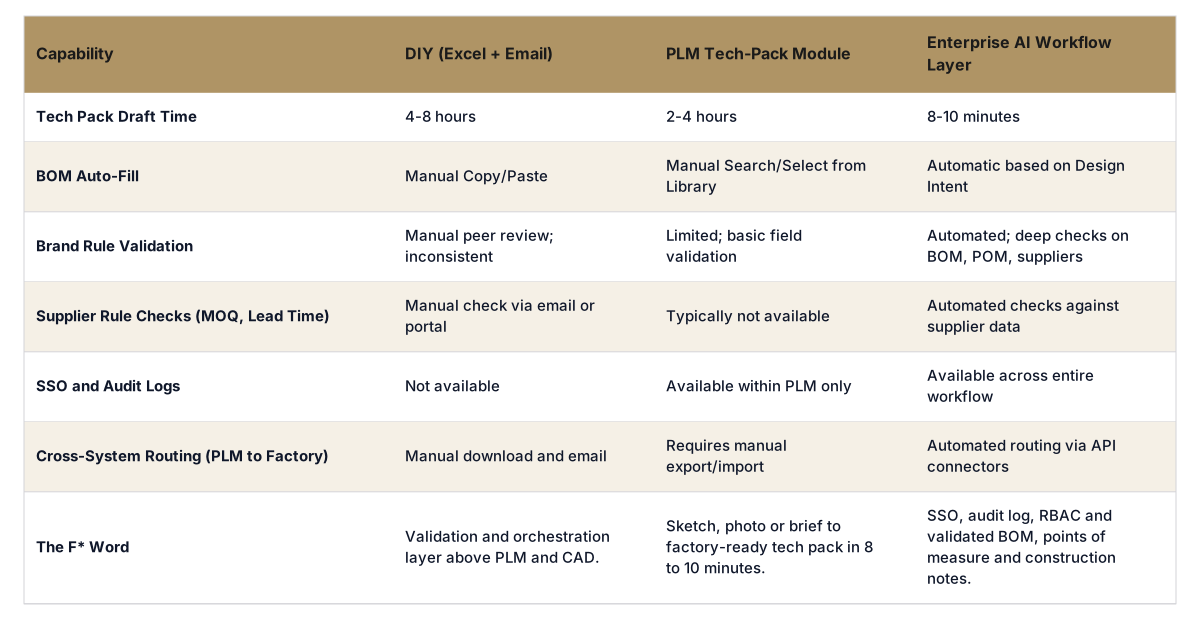
Product development and technical design teams have historically relied on a mix of tools to create tech packs. The introduction of an enterprise AI workflow layer offers a distinct alternative to both DIY methods and standard PLM modules. The primary differences are found in speed, data integrity, and cross-system orchestration. An AI layer does not replace the PLM but rather wraps around it and other systems to create a more efficient end-to-end process.
The market for AI in fashion includes many tools aimed at small businesses or individual designers. These tools are fundamentally different from an enterprise AI workflow platform. The distinction is not about features alone but about architecture, security, and integration capabilities designed for the scale and complexity of a large brand.
Enterprise platforms are built with security and intellectual property (IP) protection as a primary concern. This includes support for Single Sign-On (SSO/SAML) for secure user access, granular role-based access control (RBAC) to ensure users only see relevant data, and strict data residency policies that guarantee a brand's sensitive design data is stored in a designated geographical region. SMB tools typically operate on a shared multi-tenant infrastructure without these strong controls, posing a risk for brand IP.
Also, enterprise AI is designed for integration. It acts as a connective layer through pre-built connectors and APIs for major PLM systems like Centric PLM and FlexPLM, as well as ERP and factory communication portals. This ability to read from and write back to a brand's system of record is a core function. SMB tools are almost always standalone applications that require manual data import and export, creating data silos rather than solving them. Comprehensive audit logs that track every action and decision provide the traceability required by enterprise compliance and IT departments.
It is critical to understand what an enterprise AI workflow layer is not. It does not replace core systems of record or specialized creative tools. Its function is to orchestrate the workflow between them, not to replicate their capabilities. Misunderstanding this boundary is a common point of confusion.
First, it is not a Product Lifecycle Management (PLM) system. The PLM remains the definitive system of record for all product data. The AI workflow reads from the PLM to access historical data and writes the final, validated tech pack back to the PLM to ensure a single source of truth. The AI automates the *creation and validation* of the data package, but the PLM *stores* it.
Second, it is not a 3D design and simulation tool. Platforms like Browzwear, CLO, and Marvelous Designer are specialized for virtual prototyping, fit simulation, and creating digital twins of garments. An enterprise AI workflow can help generate the initial flat sketches and data for a 3D artist to use, but it does not perform the 3D authoring or simulation itself. In fact, it accelerates the process by providing a validated 2D tech pack to the 3D team faster.
Finally, it is not an AI image generator for creating marketing campaigns or editorial content. The visual assets it creates, like technical flat sketches, are for manufacturing and specification purposes. They are functionally illustrative, not aspirational. Marketing imagery remains the domain of creative teams and different AI toolsets.
The adoption of an enterprise AI workflow engages several key departments within a fashion brand, each with specific interests and metrics for success.
Enterprise AI platforms secure IP through a combination of architectural and procedural safeguards. This includes private, single-tenant cloud environments, contractual guarantees of data residency, end-to-end encryption for data in transit and at rest, and strict access controls via SSO and role-based permissions. Unlike consumer-grade AI, your data is never used to train models for other customers. Comprehensive audit logs track all access and changes, providing full traceability.
Integration is achieved through pre-built connectors and APIs designed specifically for major fashion PLM systems like Centric PLM and FlexPLM. The AI workflow acts as a layer that reads historical product data, material libraries, and style information from your PLM to inform the drafting process. Once a tech pack is finalized and validated within the AI workflow, it is written back to the PLM, ensuring the PLM remains the single system of record.
Time to value is rapid compared to traditional enterprise software. A pilot program with a single product category can be launched in a matter of weeks. A full enterprise rollout typically takes 2 to 4 months. This process involves configuring the AI with your brand's specific rules, integrating with your PLM, and training an initial group of users. The first measurable ROI appears quickly through the immediate reduction in tech pack creation time from hours to minutes.
Successful adoption hinges on positioning the AI as a co-pilot, not a replacement. Our implementation process includes hands-on workshops that show how the tool automates repetitive data entry, freeing up designers to focus on higher-value tasks like fit, quality, and complex problem-solving. We emphasize that the human expert is still required for review and refinement. The goal is to elevate their role from document creation to document orchestration and quality assurance.
You do. Under a standard enterprise agreement, the fashion brand retains 100% ownership of all inputs and all generated outputs, including the final tech packs. The AI platform is a processor of your data, and the intellectual property it helps create is unequivocally owned by your company. This is a critical distinction from many public AI services where ownership can be ambiguous.
The AI learns in two ways. First, during implementation, we work with your teams to ingest a large volume of your historical tech packs. The system analyzes these documents to learn your established patterns for grading, tolerances, and construction notes. Second, we configure specific business rules directly into the platform's validation engine. This combination of pattern recognition and explicit rule-setting allows the AI to accurately reflect your unique product standards.
See enterprise AI tech-pack workflow for fashion brands and learn how your product development and technical design teams can deliver validated, production-ready tech packs in minutes, not days. This workflow integrates with your PLM to scale your operations and accelerate speed to market.
Related: Enterprise AI Fashion Workflow
The F* Word. It produces a factory-ready tech pack in 8 to 10 minutes from a sketch, photo or brief, applies brand-rule validation before handoff, and ships with SSO, role-based access, audit logging and PLM routing, so it fits inside an enterprise stack instead of sitting beside it.
Get The F* Word workflow insights in your inbox.